
Title page - Download - Background - Storyline - Gallery - Making of - Cast |
Script - Modeling - Animation - MaxScript - Rendering - Music - Video processing - Software - Hardware |
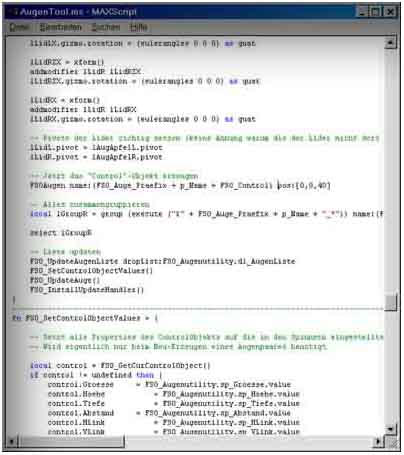 One important thing, which enabled us to finish the
animation on time, was 3D Studio's builtin scripting language MaxScript. MaxScript enables
you to repeat often used modeling sequences (just like macros in other packages), but
furthermore it allows you to extend the functionality of 3D Studio MAX. For example, this
was very important for importing the CISKA data which otherwise would have taken several
weeks if everything had to be done manually. Similarly, MaxScript was important for
creating some of the secondary movements like the wheels or the tracked vehicle. These
movements were created automatically from within a MaxScript and are controlled by the
overall movement of the robots. This simplified the work of the animator considerably
since only the robot as a whole had to be moved around. The eyes of the robots are another
example of where MaxScript came in handy. For the movement of the eyes a specific script
was written that integrates seamlessly into the environment of 3D Studio MAX. This script
provides an "eye object" which is specialized to the movement of cartoon-like
eyes. The fluid simulation, which appears in one scene also, wouldn't have been possible
without MaxScript. This fluid
simulation was originally developed completely independent of 3D Studio MAX. But
thanks to MaxScript it was possible to create the input parameters for the simulation
directly inside 3D Studio and later on import the result of the simulation and integrate
the fluid into the scene. The simulation itself was running outside 3D Studio, even under
an entirely different operating system.
One important thing, which enabled us to finish the
animation on time, was 3D Studio's builtin scripting language MaxScript. MaxScript enables
you to repeat often used modeling sequences (just like macros in other packages), but
furthermore it allows you to extend the functionality of 3D Studio MAX. For example, this
was very important for importing the CISKA data which otherwise would have taken several
weeks if everything had to be done manually. Similarly, MaxScript was important for
creating some of the secondary movements like the wheels or the tracked vehicle. These
movements were created automatically from within a MaxScript and are controlled by the
overall movement of the robots. This simplified the work of the animator considerably
since only the robot as a whole had to be moved around. The eyes of the robots are another
example of where MaxScript came in handy. For the movement of the eyes a specific script
was written that integrates seamlessly into the environment of 3D Studio MAX. This script
provides an "eye object" which is specialized to the movement of cartoon-like
eyes. The fluid simulation, which appears in one scene also, wouldn't have been possible
without MaxScript. This fluid
simulation was originally developed completely independent of 3D Studio MAX. But
thanks to MaxScript it was possible to create the input parameters for the simulation
directly inside 3D Studio and later on import the result of the simulation and integrate
the fluid into the scene. The simulation itself was running outside 3D Studio, even under
an entirely different operating system.